

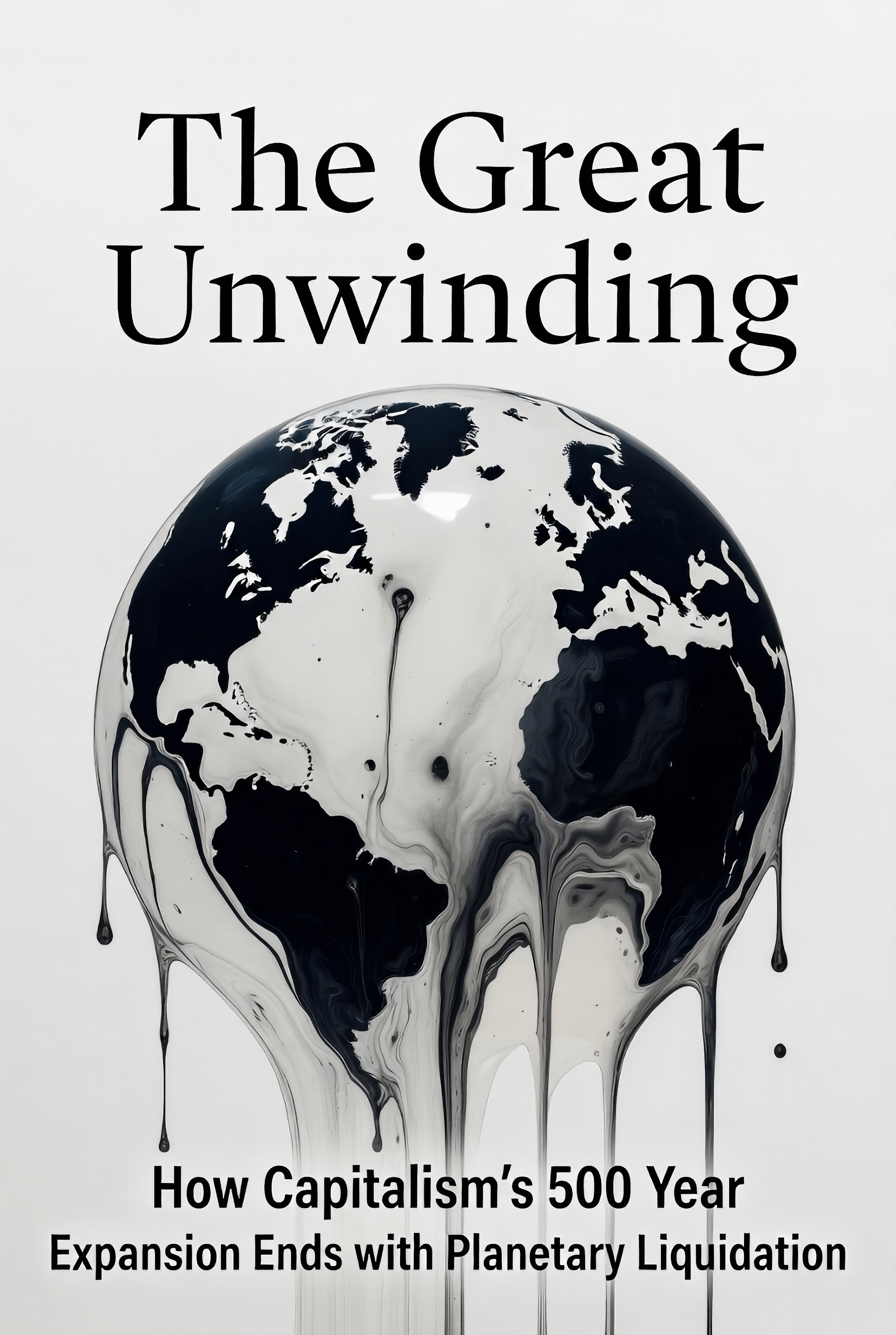
The Great Unwinding
How Capitalism's 500-Year Expansion Ends with Planetary Liquidation

Some elements of this article were previously published on the Substack Global Economic Indicator in a much shorter article titled “The Engine of Modern Conflict Part 4: The Reckoning.”
Part I: The End of the World (As We Knew It)
On February 28th, 2026, the world woke to another war. The United States and Israel launched “major combat operations” against Iran, code-named “Lion’s Roar,” following the façade of “nuclear talks” in Geneva. Missiles killed Supreme Leader Ayatollah Ali Khamenei. A girls’ school in southern Iran was struck, killing at least 170 students. Iran retaliated with missile and drone barrages against U.S. bases across the region—in Bahrain, Qatar, Kuwait, the UAE. The Strait of Hormuz, through which 20% of the world’s oil passes, became a war zone.
U.S. President Donald Trump announced the objective: “to defend the American people by eliminating imminent threats” from Iran, vowing to “destroy their missiles and raze their missile industry to the ground.” Israeli Prime Minister Benjamin Netanyahu spoke of removing “an existential threat from Iran regime.”
But this is not a new war. It is the second Eurasian front.
For four years, the first front has raged in Eastern Europe—a war of attrition between Russia and a Ukraine armed and funded by the NATO alliance; a war that has killed hundreds of thousands and devastated entire cities. Now a second front has opened in West Asia. They are the twin theatres of a single, desperate campaign: the attempt by a decaying financial empire to force one last, great liquidation of the last major sovereign asset bloc—Russia, Iran and ultimately China—to recapitalize a bankrupt core.
The internet is clogged with analysis of civilizational cycles, but this misses the point entirely. This is not the decline and fall of the world’s dominant empire, something to be catalogued in history books alongside Spain or Britain. What we are witnessing is not a reordering of the civilizational hierarchy. It is something far more profound. It is the unwinding of the system itself.
For 500 years, capitalism has survived its periodic crises through one strategy: perpetual geographic expansion. From the enclosures of English commons to the conquest of the Americas; from the scramble for Africa to the subjugation of the Indian subcontinent, the system has found new worlds to plunder. Each time profitability faltered at the core, it reached outward for a “spatial fix”—new lands, new labour, new markets to absorb its surplus and defer its reckoning.
In 1989, with the fall of the Berlin Wall, it was assumed this 500-year project had reach its logical conclusion. For the first time, the system seemed to have no meaningful outside. The former Soviet space in eastern Europe was subjugated and prostrate and the assimilation of China into the hegemonic order appeared inevitable. Only a few minor outliers remained. Francis Fukuyama called it the “End of History.” In reality, it was the end of the world—the end of the geographical frontier that had insulated the machinery of accumulation from its own internal contradictions for half a millennium. This proclamation of victory was simultaneously premature, illusory and pyrrhic. The system believed it had unified the globe, but in doing so, it had sealed its own fate.
What followed was not liberal democracy’s utopia, but the desperate, chaotic process of a system with nowhere left to go. Deprived of new worlds to conquer, it turned inward—first to loot its own public sphere, then to build a towering pyramid of speculative finance on a shrinking real economy. When that pyramid cracked in 2008, the system didn’t reform; it doubled down, treating the entire planet like a corporation in its final stages of liquidation.
Now, with two wars raging simultaneously on the Eurasian landmass, the logic has reached its terminal phase. The “End of History” was never a solution. It was capitalism’s death sentence, and we are living through the final act.
Part II: The Anatomy of the Unwinding
The Profitability Crisis and the Birth of the Debt State
The post-war “Golden Age”—high growth, rising wages, relative stability—ended decisively in the 1970s, shattered by “stagflation”: stagnant growth and high inflation that defied conventional remedies. Beneath this malaise lay the fundamental crisis of a falling rate of profit. As capitalists invested in labour-saving machinery to boost productivity, the source of new value—human labour—was progressively squeezed out of production. The system’s engine was seizing.
This was not a crisis for capital, but a crisis of capital—its ability to generate satisfactory returns was faltering. And the solution devised would reshape the next half-century: the explosion of national debt became a multifaceted tool to restore class power.
First, debt absorbed surplus capital and created fictitious profits. With productive investment stagnating, mobile capital needed a home. Government bonds became that haven—a form of fictitious capital providing steady returns even when the “real” economy faltered. By first generating then buying government debt, the financial sector could continue extracting profits through interest payments, transferring public resources to the creditor class.
Second, debt disciplined labour. The debt crisis narrative became the perfect justification for austerity. To restore profits, capital needed to suppress wage demands—the very “wage-price spiral” of the 1970s. The Volcker Shock of the early 1980s—massive recession and high interest rates—was a brutal way to force workers to accept lower wages and break union power. The resulting unemployment swelled the “reserve army of labour,” making workers compliant. Growing national debt was then used to justify cuts to social programs, suppressing the “social wage.”
Third, debt reshaped the state to serve finance. As political scientist Wolfgang Streeck argues, the state’s focus shifted from ensuring social progress for its citizens to maintaining “creditworthiness” in the eyes of international investors. This new “debt state” prioritized creditors. Tax policy shifted to favour capital income over labour income, exacerbating inequality. The state’s primary responsibility became paying its bondholders, not meeting the needs of its population.
The national debt is not a burden we all share. It is the financial reflection of a class war—a war waged by capital to restore its profits by capturing future tax revenues, disciplining labour, and reshaping the state into an instrument serving finance above all else.
The Neoliberal Counter-Revolution
This class war unfolded across multiple fronts. The war on labour—Reagan crushing PATCO, Thatcher defeating the miners—severed the link between productivity and wages. Financial deregulation freed banks for riskier speculation, redirecting investment from industry to financial engineering. Tax cuts supplied liquidity for speculation and created material incentives for the capitalist class. Antitrust enforcement was gutted, greenlighting mergers and asset-stripping.
This offensive succeeded in its immediate goal: it broke labour, re-concentrated wealth, and restored profitability. But it was deeply contradictory. It solved a distributional crisis, not a productive one—profits were restored by redistributing from labour to capital, not through innovation. It planted the seeds of financialization, ensuring reinvestment flowed into speculation rather than productive capacity. And it was inherently limited. By the late 1980s, this domestic fix was exhausted, leaving an economy addicted to credit, speculation, and inequality.
The Great Reprieve: Post-Soviet Looting and Chinese Labor
The system required new external source of vitality to consume. It arrived with the collapse of the Soviet Union and China’s opening to the global market—two historic events that provided a massive, temporary infusion.
The counter-revolution in the USSR and it’s subsequent dissolution offered forcible integration of a vast, resource-rich zone. Under IMF-directed “shock therapy,” state assets were sold at fractions of their value to oligarchs and Western capital. Hundreds of billions in capital fled to Western banks. Eastern Europe’s educated, low-wage labour pool disciplined Western European wages. This “geopolitical dividend” was a one-time jolt of accumulated wealth.
China process of Reform and Opening Up was also central to the engine of reprieve. The integration of China, India, and the former Eastern Bloc effectively doubled the global labour force. China—with its well-educated, low-wage labour and currency peg—became the workshop of the world, exporting sustained deflation that lowered prices even as Western wages stagnated creating the illusion of prosperity. For Western corporations, offshoring captured the gap between high consumer prices and ultra-low Chinese costs. The profit share soared, but from global wage arbitrage, not productive innovation.
China’s massive trade surpluses were recycled into U.S. Treasury bonds, suppressing interest rates and fuelling historic credit bubbles. The West consumed cheap goods on credit, financed by the country supplying them.
These twin reprieves provided the fixes the crippled system needed. But they accelerated underlying pathologies. They made financialization irresistible—with super-profits flooding markets, capital poured into speculation rather than production. They created fatal dependencies on perpetual Chinese deflation and capital inflows. And they were inherently temporary. Once post-Soviet assets were stripped, Chinese wages began rising and China and Russia reasserted their sovereign development, the sugar rush would end. The system used the reprieve not as an opportunity formulate a strategy of transition, but to build a larger, more fragile edifice atop the same crumbling foundation.
2008: The Sugar Rush Ends
By the mid-2000s, the effects were fading. The post-Soviet asset grab ended as a resurgent Russia reasserted its sovereignty; Chinese wages began rising as a rejuvenated nation began climbing the value chain. With the external sugar rush exhausted, the unresolved contradictions exploded inward. The 2008 crisis was not an accident but the logical reckoning for an economy that had substituted debt and speculation for production.
With profitability stagnant, unprecedented capital chased returns in finance itself. The U.S. housing market became the epicentre—banks pushed subprime mortgages, packaged them into complex securities, and sold them globally as high-grade investments. Credit rating agencies, paid by the banks, fraudulently labelled these time bombs “AAA.” When the bubble burst, the pyramid was revealed as worthless.
Confronted with collapse, states intervened not to help the public but to preserve the financial architecture. Trillions in public money bailed out the banks, socializing massive private losses. This swap of private for public debt marked the start of a fiscal regime, where central bank policy would forever be constrained by the need to monetize the towering public debt.
The most profound impact was the consolidation of financial power. The crisis proved the financial sector was not servant to industry but its parasitic master, “too big to fail.” The response—printing money to re-inflate asset prices—explicitly prioritized the financial pyramid over living standards. Austerity was imposed on the public, limitless liquidity offered to capital.
Capitalism as Corporate Liquidation
The neoliberal counter-offensive and subsequent financialization transformed the system’s fundamental logic. With the geographical frontier closed, capitalism mutated. It could no longer grow by incorporating new territories, so it began to grow by liquidating its existing assets. This is the defining characteristic of the unwinding phase. When the logic of the leveraged buyout became a civilizational raison d’être.
The classical model of industrial capitalism—for all its manifest cruelty and barbarity—was at least a going concern, generating profit by investing in production. The financialized model of the 21st century is a liquidating trust. Its sole imperative is to maximize short-term payout by selling off assets and loading the entity with debt before ultimate collapse.
This asset stripping now operates on a planetary scale—from post-Soviet oil fields to British water utilities to American public pensions. Debt fuels extraction, creating a fragile veneer of growth masking stagnant production. Crisis becomes opportunity—each cycle functions as a brutal transfer of wealth upward, stripping the public sphere to recapitalize the private.
This dynamic extends beyond borders. When central banks engage in Quantitative Easing, they create money to purchase financial assets, inflating stock and real estate prices. This liquidity floods into emerging markets, purchasing sovereign debt and real estate—a modern form of neocolonial expansion. When the Fed tightens, the money withdraws, triggering currency crises and austerity, forcibly opening these economies to further asset stripping.
By the late 2000s, the system had consumed everything digestible within its core. Internal fixes were exhausted. The liquidation machine had picked its own domestic sphere clean.
What remains when there is nothing left to liquidate at home? The logic becomes predatory. It looks outward to the last remaining pools of real, unencumbered value not yet absorbed into the pyramid’s foundation. This is the bridge to geopolitics: the desperate attempt to find new balance sheets to loot, new sovereign assets to strip, before the liquidation is complete.
Part III: The Hunt for Collateral – When the Pyramid Must Feed on Nations
From Internal Extraction to External Plunder
By the close of the 2008 crisis, the financialized core had reached an impasse. The internal fixes that sustained it for decades—labour suppression, privatization, asset bubbles, household debt extraction—had been pushed to their limits. Each new round of quantitative easing produced diminishing returns. The system was consuming more value than it was generating.
This is the condition of a liquidating trust that has exhausted its own balance sheet. It must find new balance sheets to loot—pools of real, tangible value that remain outside its grasp. But unlike the 16th century, unlike the 19th century, unlike even the post-Soviet windfall of the 1990s, there are no new worlds. The only remaining pools of value are the sovereign assets of nations that have resisted full subordination to the Western financial pyramid. The hunt for collateral has become geopolitical because the only remaining targets are geopolitical.
What the Pyramid Actually Needs
The pyramid requires collateral—real assets that can be securitized and leveraged into new fictitious capital. It requires balance sheets integrated into the Western financial system; their assets packaged into derivatives. It requires central banks subordinated to the dollar system. It requires state-owned enterprises privatized; their profits diverted from national development to shareholder returns.
These are the concrete objectives that have driven every major intervention of the past quarter-century:
Iraq and Libya: Not about weapons of mass destruction or humanitarian intervention. About unlocking state-controlled hydrocarbon reserves. Before invasion, Iraq’s oil industry was state-owned, funding national development outside Western finance. After, it was opened to international oil companies, its reconstruction funded through debt integrating it into the system it had resisted. Libya followed the same template. Gaddafi’s crime was holding Africa’s largest oil reserves outside the dollar system and funding development that bypassed Western financial institutions.
Venezuela: Not about democracy—or narco-terrorism, or Hamas. It’s about the last major oil reserve in the Western hemisphere not fully integrated into the dollar-debt system. A state using oil wealth for domestic social development rather than Wall Street enrichment was intolerable. Sanctions and isolation have one objective: force economic change, open its oil to Western capital. A starving nation is compliant. Its assets can be had at fire-sale prices. It is also leverage over the ultimate prize, China.
Iran: This is the new front. Not about nuclear weapons—the pretext under which negotiations had been proceeding, with both sides reportedly nearing a provisional agreement that would have allowed Iran to retain limited enriched uranium under strict conditions. But on February 28, diplomacy was abandoned for bombing. Iran holds the world’s fourth-largest oil reserves and controls the Strait of Hormuz, through which 20% of global oil passes. Its integration would inject fresh collateral into a starving system. Its continued autonomy is a standing reproach—and the strategic key to confronting China, because whoever controls Iran’s energy chokepoints holds a knife to China’s economic throat.
Russia: Not about Ukraine or NATO expansion, though those were the mechanisms. About neutralizing a resource superpower demonstrating an alternative model: national wealth backing national sovereignty, not Wall Street derivatives. Russia’s crime is its existence as a sovereign entity with vast resources and the willingness to use them in defence of its own interests.
NATO expansion was designed to force a fatal dilemma. If Russia acquiesced, it became a neutered vassal. If it resisted, sanctions and isolation would trigger fragmentation into weak, pliable statelets—each a new frontier for asset stripping. The 2014 coup in Ukraine was the pivot, designed to permanently pull that country from Russia’s sphere.
Russia chose resistance. The result has been a hot war devastating Ukraine and triggering unprecedented sanctions. But it has also produced something unanticipated: the consolidation of a Eurasian bloc, accelerated de-dollarization, and proof that a resource-rich state with sovereign policy can survive Western financial warfare. The strategy misfired—but its objective remains.
China: This confrontation clarifies the whole picture. China is not another resource-rich state awaiting integration. It is an entire economic civilization organized on a different logic. State-directed. Productive. Building infrastructure across three continents and accepting payment in local currency rather than dollar-denominated debt. The Belt and Road Initiative is an alternative network of real productive infrastructure and capital; a parallel system that does not require the perpetual inflation of fictitious claims.
China’s crime is its success. According to research by Isikara & Mokre the cumulative international value transfers from the Global South to the North from 1990 to 2015 exceed seventy trillion euros. The largest net losers: Brazil, Mexico, Indonesia, Russia. The largest net gainers: Japan, Europe, the United States. But since 2008, China has become a net gainer. How? Not through financialization. Not by capturing the financial systems of the Global South. But through high investment, technological advance, and a rising organic composition of capital. It has escaped perpetual value extraction. It has demonstrated another path exists.
This is intolerable. Not because it threatens American jobs or the Indo-Pacific order. Because it exposes the pyramid as not the natural order, but a specific, contingent, and increasingly dysfunctional mode of accumulation that survives only by foreclosing alternatives. A system that must prevent success elsewhere to sustain itself is a system in hospice.
The Twin-Theatre Strategy
The hunt for collateral has unfolded across two primary theatres, complementary fronts in the same existential campaign. As Russian Foreign Minister Sergey Lavrov observed in the wake of the Iran strikes, the West operates on a simple “either-or” principle—“either you’re with us, or you’re against us”—applying the same “divide and conquer” logic in Ukraine, the West Asia, the Caribbean, and beyond .
Eastern Europe – The First Front: The Ukraine war, now entering its fourth year, was engineered through NATO’s relentless eastward expansion—a one-way bet to force Russia into a fatal dilemma. When Russia intervened in 2022, the script appeared to follow its course: sanctions, isolation, a protracted war of attrition to bleed the Russian economy and trigger internal collapse. But it misfired. Rather than fracturing, Russia’s economy adapted and its partnership with China deepened.
West Asia – The Second Front: The strategy in West Asia evolved through three phases. Direct conquest (Global War on Terror 2001-2008) ended in catastrophic failure—costs exceeded any conceivable return. Covert regime change (Arab Spring 2011-2013) foundered as the U.S. lost control of the forces it unleashed. The third phase which started with the Israeli response to October 7th is now reaching its logical conclusion. A direct confrontation that appears intended to culminate in a full regional assault on Iran.
The Unified Objective: Despite misfires in Ukraine, the objective remains constant across both theatres: forced disintegration and asset-stripping of the major powers resisting full subordination to the Western financial pyramid. Control West Asia to threaten China’s economy via the Strait of Hormuz; encircle Russia to weaken its integrity. Push them to the brink where their resources can be liquidated into the Western pyramid.
The Parasite and Its Host
If finance capital is globalized, its elites operating across borders, why do they require American military power? Contemporary finance capital is genuinely international. It has no home. It extracts value from every continent.
But it has no army. It cannot seize oil fields, compel arbitration, or overthrow governments. It is parasitic—not upon any single host, but upon the residual military capacity of the United States.
This is the true function of the “American” part of the empire in its twilight: not to advance American national capital, but to serve as global enforcer for a stateless oligarchy. The dollar is both the currency this oligarchy seeks to transcend and the weapon it wields against rivals. The U.S. military is both the institution this oligarchy starves of funding and the instrument it deploys without limit for geopolitical extraction.
Without American coercion, the pyramid cannot access required collateral. Without the pyramid’s financing, American coercion cannot continue. Each enables the other; each consumes the other. This is not strength. It is mutual addiction in its final, convulsive phase.
The Violence Turns Inward
The hunt for external collateral has a domestic parallel. As the pyramid’s need becomes more desperate, the system turns its violence inward. The structural crisis is accelerating the mutation of Western democracies into something far more sinister. The surveillance state has crystallized into a digital panopticon where Central Bank Digital Currencies promise real-time financial censorship. This infrastructure is normalized on the streets by anonymous, armed agents and tacitly accepted militias.
The once utopian rhetoric of Silicon Valley has soured into dystopian managerialism, dismissing democratic processes as obstacles to efficiency. Fascism in the 21st century does not require jackboots. It is the moment capitalism discards the facade of liberal democracy and openly rules through violence to maintain a failed system.
This inward turn is not separate from external wars. It is the same logic: extraction from whatever remains, by whatever means necessary, to postpone collapse one more day. The domestic population, like the populations of Iraq, Ukraine, and now Iran, is simply another pool of assets to be liquidated. It is the toolkit of empire turned inward.
Part IV: The Choice That Is Not a Choice
We are told the choice is between the existing order and chaos, American leadership and Chinese domination. This is the framing of those who cannot imagine—or permit—its replacement.
The actual choice is between the slow asphyxiation of debt-peonage and the catastrophic convulsions of a system refusing to expire quietly. Between accepting that the pyramid cannot be saved, and accelerating the wars fought in its name.
This is not a hopeful analysis. It does not conclude with policy recommendations. The pyramid cannot be reformed. Its logic is a structural imperative driving every actor toward the same destination. Individual players have marginal agency; they are prisoners of a game they did not design. Their rational choices, aggregated, produce systemic irrationality.
The only question is how long the propping can continue, and at what cost. The wars in Ukraine and now Iran, the sanctions on Venezuela, the extraction from the Global South—all are the cost. They are not unfortunate side effects. They are the system’s essential operating expenses, the price of delaying its reckoning one more quarter, one more election cycle.
The Illusion and Its Exposure
Imagine the players in a high-stakes poker game realized the bank was empty and they were playing for coloured chips. This is the moment the system fears above all others. Not defeat in any conflict. The loss of belief. The recognition that the wealth everyone chases exists only as long as everyone pretends.
The hunt for geopolitical collateral is therefore not primarily about the assets themselves. It is about maintaining the illusion that something real exists behind the paper. Each seized oil field, each bombed capital, each subordinated central bank is a signal to markets: the pyramid still has real foundations. The chips can still be cashed in.
This is why the conversion of fictitious capital into real capital is so destructive. The collateral is not added to the pyramid’s base; it is burned to fuel the illusion that the base exists. The oil fields of Iraq produce less under occupation than under sanctions. Libya remains a failed-state hellscape. The Russian industrial capacity has not been opened to Western capital but has instead reoriented toward Eurasia. The infrastructure of West Asia is being destroyed as we speak.
The system is consuming its own future to prolong its present. This is the behaviour of an organism that cannot recognize its own mortality, thrashing against the inevitable with increasing violence and diminishing returns.
The Reckoning
There will be a reckoning. Not because justice demands it. Because a pyramid with a shrinking base cannot grow indefinitely. Because a system that must constantly escalate has nowhere left to go.
The form is not predetermined. It could be the expansion of the current wars into a broader conflagration—NATO Secretary General Mark Rutte has already signalled the alliance’s readiness to invoke collective defence provisions in support of the U.S. operation against Iran . It could be the quiet collapse of an overextended financial institution revealing the emperor has no clothes. It could be the slow disintegration of American coercive capacity, leaving the global enforcer unable to enforce. It could be the continued construction, by China and its partners, of an alternative economic order that simply renders the Western pyramid irrelevant.
What it will not be is a return to stability within the existing framework. That framework is exhausted. It has extracted everything extractable from its traditional domains. It has subordinated every state vulnerable to subordination. What remains are the powers that cannot be subordinated without war, and the assets that cannot be financialized without destroying them.
The terrible irony is that victory in either current confrontation would not resolve the underlying diagnosis. It would only delay the inevitable, while consuming collateral that might have supported a genuine transition. The system’s bid for survival through escalation is what makes total collapse—or catastrophic war—most likely. It is the final logic of a mode of accumulation that has outlived its function and now survives only by cannibalizing its—and our—own future.
There is no moral, no prescription for how to avert catastrophe. The catastrophe is already underway. It has been underway for decades wearing the masks of austerity and structural adjustment; humanitarian intervention and antiterrorism; great power competition and democracy promotion. The task is not to prevent what cannot be prevented, but to recognize it for what it is: not a series of disconnected crises, but one crisis with many fronts. Not a failure of policy, but the successful execution of a system whose success is indistinguishable from collapse.
The pyramid stands, for now. Its peak is invisible, its base is cracking, and its architects are frantically stuffing the last available bricks of real collateral into its foundations—in the fields of Ukraine, in the streets of Tehran, in the burning oil wells of a region now at war. They believe they are saving the edifice. They are only delaying its fall, while ensuring that when it falls, it takes everything down with it.
This is not pessimism. It is realism of the only kind that remains useful: the realism that refuses to mistake the system’s survival for health, its escalation for strength, its violence for purpose. The pyramid will fall. The only remaining questions are when, and how, and what we are willing to build from its ruins.
The February 28th strikes on Iran were not a departure from this reality. They were its most honest articulation yet.
(P.S. My work is completely suppressed on social media, literally no one sees it, so you would be doing me a huge favour if you could give me a follow on X and share some work to help break the cycle. Many thanks.)
This is the best analytical framework and in depth study on the current international (global) situation. The author style and logic remind me of Peter Gowan, whom we have lost painfully early... Excellent, and honestly, I do not care whether it is "grim" or "hopeless", because knowing thus facing to the current stage of affairs -according to my view-far better, than anything else. This analysis equips me to think more, read more and if possible, write more. Thank you indeed. K Ferber (economic historian).
OMG…..I hadn’t looked at the world through those lens’s (which are pretty grim) but what you’ve suggested makes a lot of sense and yours is a really well thought out essay.
Greed is the issue at the heart of capitalism. More always seems to want more, and more is celebrated. I get what you’re saying that adjustments would only have slowed the decline but I’m not fully convinced that capitalism was always a fait accompli. We (the people)didn’t put the effort into checking out who we supported, we didn’t take the time to educate ourselves on the options for governance, we didn’t stop to ask if we really needed a purchase (wanton consumerism), we didn’t challenge governing parties, we don’t take the time to analyse what we are being fed by media (even now when it’s so easy to fact check things). We hold a lot of responsibility.
Maybe simple local Saturday get togethers for teenagers and young adults regarding these issues would be worth thinking about - that group love talking politics and are genuine in their wish to learn more about options and different systems. I’d like to see the voting age lowered to 16 years. In my more frustrated moments I’d like to have some sort of test you need to pass before you can cast your vote (just to indicate you have some grasp on politics and the political system).
Capitalism is a failed system and the imperialism that accompanied it for most of its journey was hideous. In more recent decades we could have moved to more socialist models but greed and complacency seem to have played their part - yes other powerful forces were there but they fed off our inaction and became stronger because of it. We regular people have to take responsibility for the mess we’ve created. I still believe (maybe naively) that something better will emerge. But, I also believe it will involve living differently, more modestly, putting in effort into our politics, turning towards local community again, challenging media bs narratives, taking time to teach our children critical thinking skills and facilitating discussions with them to explore values and ethics. I believe we still have power but do we want the fight?
Thank you for a very thought provoking essay.