

Why War with Iran?
Israel's Failed Strike Won't be the End.

In the early morning of 26 October, Israel launched what appears to have been a failed, large-scale strike against Iran. Reports indicate that up to 100 aircraft with refueling flights were launched against the Islamic Republic but with most of the aircraft returning to base without reaching their designated targets. Some reports indicate that the mission was aborted due to the presence of unexpected, unidentified air defense systems however little is clear. In the aftermath of the failed attack Israel and its allies in the collective West declared victory. This strike is however unlikely to be the end.
Israel’s actions in the aftermath of October 7th have been a relentless drum beat toward a wider regional war, a war that US Imperial interests seek to use as a pretext for intervention against Iran. It is not the result of incompetence or political paralysis in Washington as the mainstream media narrative suggests. Instead, it is the most recent iteration of Washington’s 21st Century quest to bring what the US sees as the remaining intransigent elements in West Asia to heel and consolidate control over the region’s resources. It is also a crucial part of a broader strategy to contain China’s growing economic, technological and political influence around the world.
Iran’s energy reserves and proximity to the Caspian Basin has long made regime change a US foreign policy goal in and of itself. The US Energy Information Agency estimates the Caspian Basin has 48bn barrels of oil and 8.3 trillion cubic metres of natural gas in proved and probable reserve making it the largest discovery since the North Sea oil and gas and comparable to the whole of North America.
At present, Iranian controlled reserves in the Caspian Basin are estimated to be 30% of the regions total, 1.5 times greater than Azerbaijan’s total recoverable reserves and enough to potentially supply 20% of the EU’s total energy needs on an annual basis. Iran would also provide a vital foothold on the Caspian Sea giving the US greater leverage over countries in the region and, importantly, challenging the dominance of the Russian Caspian Flotilla.
In many ways Israel can be viewed as an extension of US foreign policy in a geo-strategically vital region of the world. Israel was effectively created by the British as a way to garrison a region that became vital to British Imperial interests as the Royal Navy transitioned from coal to oil. It fell under US jurisdiction after WWII as the Imperial mantle shifted to the US.
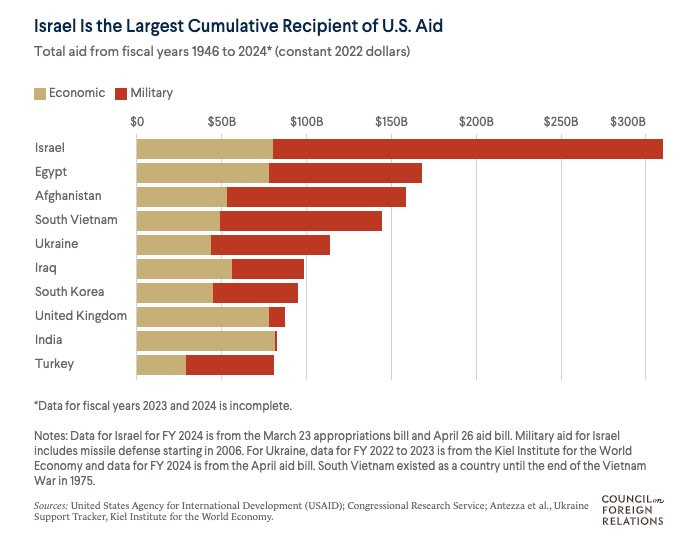
According to the Council on Foreign Relations, Israel has been the largest cumulative recipient of U.S. foreign aid since its founding almost all of which since 2007 has been military aid. The US has also provisionally agreed to provide Israel with an additional USD3.8bn a year until 2028 irrespective of the outcome of the next election. Given the scale of military assistance - both financial and material - the US and other NATO countries have provided throughout Israel’s ‘response’ to October 7th it is clear that Israel’s actions broadly align with Washington’s desired course of action.
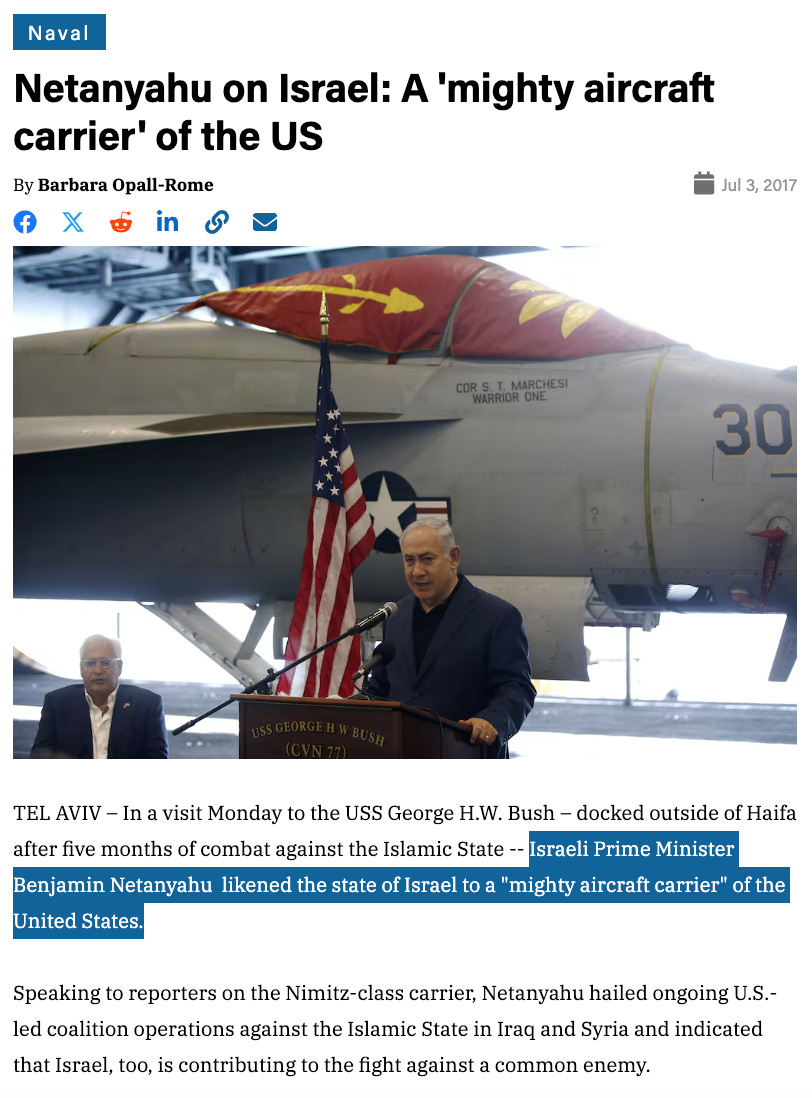
Israeli Prime Minister Benjamin Netanyahu himself has likened the state of Israel to a "mighty aircraft carrier" of the United States. Clearly, one of reasons Israel receives so much aid is to provide plausible deniability for US Imperial actions in West Asia. This does not mean Israel’s actions align completely with US foreign policy objectives but there is, at the very least, a significant overlap.
A 2009, Brookings Institution policy paper titled “Which Path to Persia? Options for a New American Strategy toward Iran,” details possible options for achieving regime change. These options range from exploiting ethnic divisions to create internal unrest to initiating and then later sabotaging potential nuclear deals - check. Chapter 5 of the report outlines how Israel could be encouraged to stage a series of provocations that draw Iran into a conflict creating a pretext for the US to either covertly or overtly assist Israel in striking Iran.
Screenshot: “Which Path to Persia.”


Washington’s long-standing hostility toward Tehran has been obvious for decades with repeated calls for strikes against the country. However, immediately prior to Israeli Prime Minister Benjamin Netanyahu’s July speech to the US Congress, US Secretary of State Anthony Blinken announced that Iran was one to two weeks away from acquiring the fissile material necessary for a nuclear weapon.
Given the timing and the circumstance, this was intended as a green light to Netanyahu who has repeatedly claimed such a situation would necessitate Israeli action. The subsequent reception to Netanyahu’s speech in which he spoke about the need to strike Iran and the 58 standing ovations he received were confirmation of Blinken’s green light.
The current moves by US Imperial interests and their proxy, Israel, are part of a late-stage gambit to consolidate Washington’s control over the global financial order and prevent the world escaping the shadow of US neocolonial control. Controlling the resources of West Asia is, and has been for decades, key to the US strategy of containment toward China’s growing economic, political and technological power. A strategy that is becoming increasingly desperate with the power of the US Empire visibly waning and the perceived window of opportunity rapidly closing.
As early as September 2000, The Project for a New American Century’s report “Rebuilding America’s Defenses: Strategy, Forces and Resources for a New Century,” which in many ways laid the ideological foundation for the War on Terror, notes the focus of US strategic competition in the 21st Century shifting to East Asia. Subsequent policy papers like the Council on Foreign Relations 2015 report “Revising US Grand Strategy toward China” makes it explicitly clear that the US perceives the following possibilities as a challenge to US vital national interests:
· replace the United States as the primary power in Asia;
· weaken the U.S. alliance system in Asia;
· undermine the confidence of Asian nations in U.S. credibility, reliability, and staying power;
· use China’s economic power to pull Asian nations closer to PRC geo- political policy preferences;
· increase PRC military capability to strengthen deterrence against U.S. military intervention in the region;
· cast doubt on the U.S. economic model.
Screenshot: “Rebuilding America’s Defenses”


Screenshot: “Revising US Grand Strategy toward China”


China’s reliance on West Asian energy resources and the US military’s reliance on sea power to project force led the US to an energy embargo strategy to contain China in the event of a conflict. The US believes that domination of West Asian energy reserves combined with naval blockades around key international trade choke points like the Straits of Malacca and Hormuz would be sufficient to throttle the Chinese economy leading to domestic unrest and possibly regime change. This conflict could presumably be sparked by activating Washington’s third proxy – the island of Taiwan - to move overtly toward independence.
It is important to remember that the US initiated regime change operations in both Ukraine and Taiwan in 2014.
The strategy of controlling West Asian energy resources as a practical policy has adopted three distinct approaches in the 21st Century; the War on Terror, the Arab Spring and the War of the Proxies (Ukraine, Israel, Taiwan.)
First iteration of this strategy, the War on Terror, saw the overt use of military force to seize control of and impose regime change on what the US considers recalcitrant regimes in the region. As US General Wesley Clark, former Supreme Allied Commander Europe and commander United States Southern Command pointed out, the immediate goal of the War on Terror was to implement military driven regime change across seven countries: Iraq, Syria, Lebanon, Somalia, Sudan and Iran.
This strategy ultimately failed with US forces militarily bogged down in the region having failed to secure the first strategic objective of Iraq. In May 2007 the Department of Veterans Affairs’ Gulf War Veterans Information System reported over 73,000 US service personnel deaths in the conflict. The report stated the following:
Total U.S. Military Gulf War Deaths: 73,846
· Deaths amongst Deployed: 17,847
· Deaths amongst Non-Deployed: 55,999
· Total “Undiagnosed Illness” (UDX) claims: 14,874
· Total number of disability claims filed: 1,620,906
· Disability Claims amongst Deployed: 407,911
· Disability Claims amongst Non-Deployed: 1,212,995
· Percentage of combat troops that filed Disability Claims 36%
NB Source: http://www1.va.gov/rac-gwvi/docs/GWVIS_May2007.pdf (PDF file appears to no longer be available online however an archived version appears here: http://www.viewzone2.com/gulfwar.deaths.pdf )
Screenshot: DVA - Gulf War Veterans Information Service May 2007


The military debacle in Iraq prompted a rethink of US global strategy leading to refocusing of military assets to East Asia, signalled by President Barack Obama’s announcement of a “Pivot to Asia.” At the same time, the US quest for domination of West Asia’s resources morphed into what would become known as the ‘Arab Spring.’
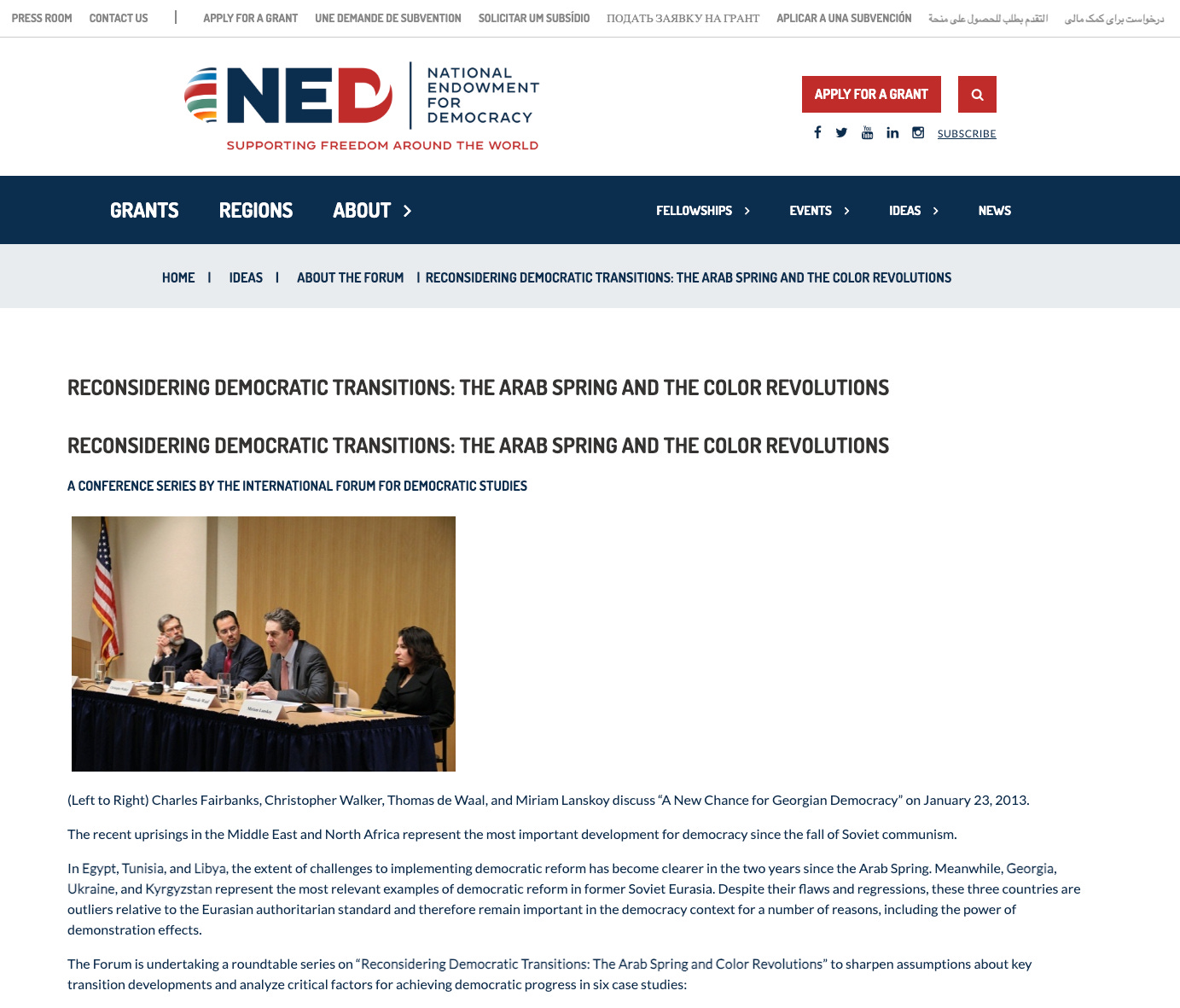
The Arab Spring transformed US policy in the West Asia region from one of overt military driven regime change to covert, internally instigated regime change with the help of US big-tech and covert US intelligence coordination and funding. Essentially a US-UK-Israeli enterprise, it was planned by the Obama admistration and largely overseen by Secretary of State Hillary Clinton. Despite initial successes the project soon foundered as the US lost control of the forces it had unleashed and were ultimately unable to shape events as had been predicted.
The following link on the National Endowment for Democracy website shows video discussions of how the US strategy of domestic driven regime change was starting to go wrong in 2013 and how the NED planned to correct it.
The current phase of West Asia policy is to use Israel as a proxy to initiate military action against Iran to draw in the involvement of the US and other NATO countries. One day after October 7th, the US announced the deployment of 2 naval carrier groups to the region - the Ford and the Eisenhower. Such a force posture was at the time both inappropriate and excessive to supporting a limited Israeli response to Hamas in Gaza and was clearly aimed at projecting force against a far more powerful adversary, presumaby Iran. Given the logistics involved in such a deployment it seems likely planning was in the pipeline for a long time.

On October 8, 2024 The Atlantic Council released its report “The Future of US Strategy toward Iran: A Bipartisan Roadmap for the next Administration,” making the case that irrespective of who wins the upcoming US election, bipartisan policy must be locked in to a military confrontation with Iran for at least the next Presidential term. Given the urgency the US foreign policy establishment attaches to initiating conflict with Iran it seems likely a situation will be manufactured to ensure whoever wins the 2024 US Presidential election will be left with no choice but to escalate military action against Iran.
“The United States needs a bipartisan strategy toward Iran that can be maintained across several administrations, one that works patiently and resolutely to counter Iran’s efforts to dominate the Middle East, drive the United States out, destroy Israel, and threaten Arab allies.” – Atlantic Council.
Israel’s seemingly aborted attack on Tehran provided the US with the opportunity to draw a line under the current debacle and distance itself from Israel, but given the US views the stand off as an essential component in a wider, existential crisis it is very unlikely to take it. Especially given the urgency of the situation with US Imperial power visibly waning and the window for action against China quietly closing.
Russia will never allow Iran to go under because of its need for the North-South transportation corridor. That makes Iran almost as important for Russia's survival as Ukraine. With Russian backing, Israel can't do much and the US is unlikely to want a direct fight with Russia over Iran.
A lot of this 'analysis' relies on rather muted reactions from Americas opponents. I think they really need to up their war gaming as much of it is just plain stupid... as if they can act overseas without impact at home.. without significant losses to themselves or allies... that regimes might change in favour of their adversaries... its crazy.